
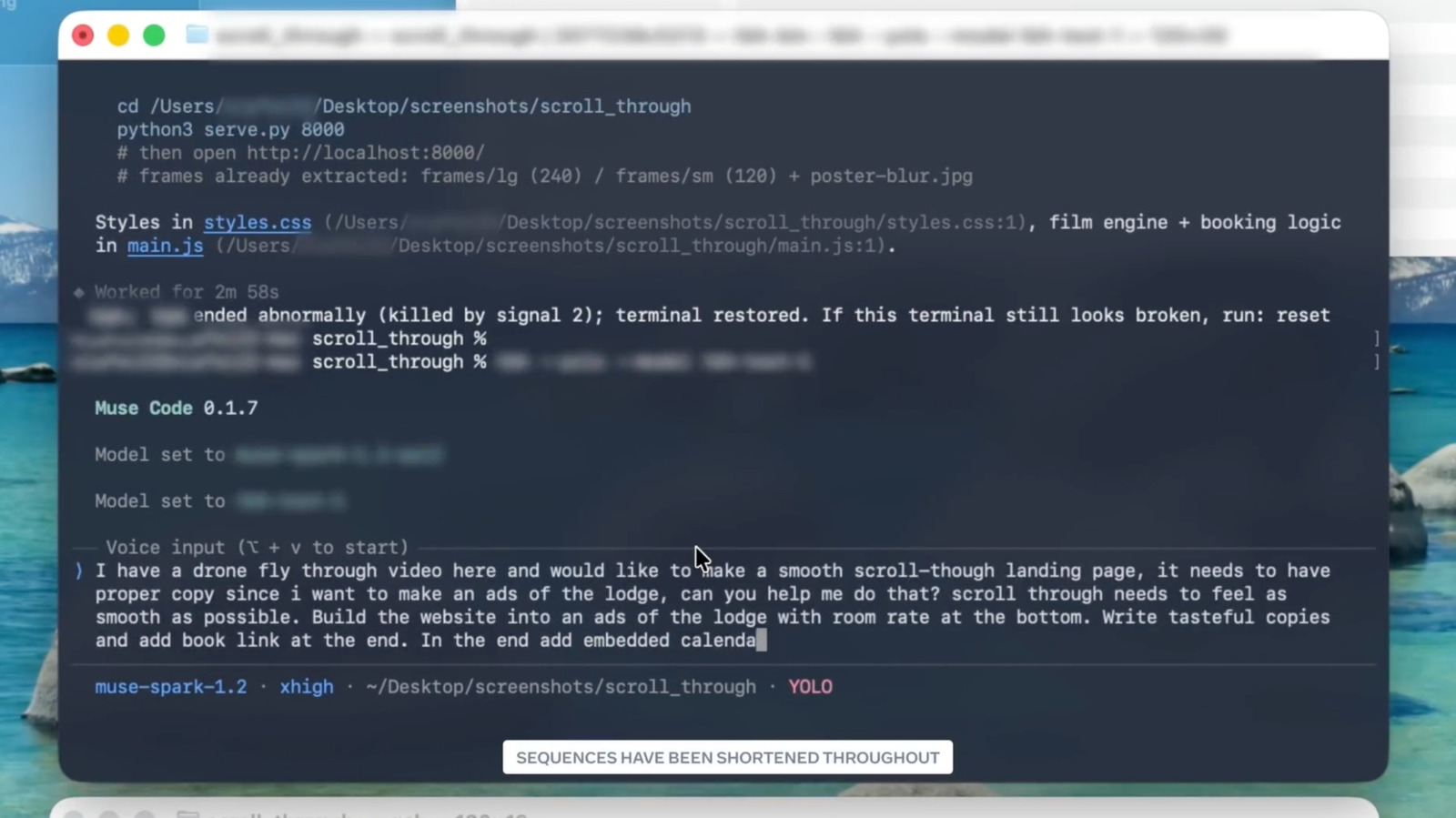
Meta has launched an early beta of Muse Code, a terminal-based coding agent designed to compete with existing tools like Anthropic's Claude Code and OpenAI's Codex. Unlike its competitors, Muse Code lacks a dedicated graphical user interface, operating entirely through the command line on macOS and Linux systems. The tool is powered by Muse Spark 1.2, a new iteration of Meta's AI model specifically optimized for software development workflows.
The agent is capable of managing complex engineering tasks, including planning architectural changes, writing code, and validating results. A notable feature of the system is its ability to coordinate multiple persistent sub-agents that remain active throughout a session. According to Meta, the tool includes a local event log that tracks model calls, tool usage, and edits, which allows developers to resume work even if a session crashes.
Meta is positioning Muse Code as a cost-effective alternative to other industry-standard coding agents. By default, the tool utilizes a pay-as-you-go pricing structure of $1.25 per million input tokens and $4.25 per million output tokens. The company also introduced a contributor tier for users who agree to provide feedback on the agent's performance, which significantly reduces costs to $0.10 per million input tokens and $0.20 per million output tokens.
The underlying Muse Spark 1.2 model features improvements in code generation, debugging, and codebase understanding. Meta claims the model was trained using rejection-sampled harness trajectories and specific recipe optimizations for sub-agent coordination. Developers can access the tool by executing a single installation command in their terminal, though the company has not yet provided a standalone application interface for the software.
Sources
- EngadgetMeta introduces Muse Code, its take on a coding agent
- VentureBeatMeta enters the AI coding wars with Muse Spark 1.2 and Muse Code with persistent async background agents
- AppleInsiderMeta's Muse Code is yet another AI coding agent on macOS
- 9to5MacMeta launches Muse Code AI coding agent for macOS and Linux