
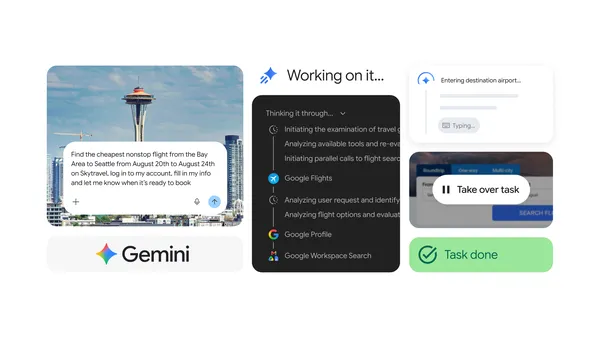
Google has introduced a significant update to Gemini Spark, its personal agent designed for task automation, by enabling direct integration with the desktop version of Chrome. This new capability allows the agent to utilize a user's logged-in accounts and saved passwords to navigate websites and complete complex web-based errands. The feature is intended to assist with repetitive tasks, such as researching flight options or scheduling appointments for saved apartment listings.
The integration functions by leveraging the auto-browse technology previously introduced for Gemini within Chrome earlier this year. When active, users will see a specific indicator in the browser's top bar to signal that the agent is engaged. To ensure security, the system includes protections against prompt injection and requires explicit user approval for sensitive actions, such as processing payments or finalizing bookings.
This update is currently limited to users in the United States, with Google planning to expand the availability of these browser-based automation features to additional regions in the future. The new Chrome integration joins a growing suite of tools for Gemini Spark, which already includes Connected Apps for Workspace and Search, personal intelligence features, and remote computer code execution capabilities.
In addition to the new browser functionality, Google is broadening the reach of Gemini Spark by extending access to Google AI Pro subscribers in more than 160 countries. This international rollout follows a full release in the United States earlier this month. The expansion marks a continued effort to scale the agent's availability since its initial launch in May 2026.
Gemini Spark has received frequent updates since its debut, including the recent introduction of Model Context Protocol (MCP) integrations and the release of a dedicated macOS application for local desktop control. These developments are part of Google's broader strategy to position the agent as a comprehensive tool for managing daily digital workflows across various platforms and environments.